
The method
Zero-based and allocation budgeting: allocation is money used
Allocation budgeting is the envelope method with a ledger behind it. In Moneva you plan an entry, allocate money to it from the income you expect, and the moment that money is set aside it counts as used; the payments you record on the entry are its execution. Zero-based budgeting is the same model with one extra rule: the plan must equal the income, to the franc.
- Four numbers on every line
- Nothing allocated before income
- Free = income − money used
Four numbers on every budget line
Every line of a Moneva budget carries a planned amount (what you intend to spend), an approved amount (what passed review; equal to planned when no approval is required), an allocated amount (what has been released for spending) and an actual amount (what has been recorded and approved as spent). Available is allocated minus actual, committed and pending. For a personal budget the first three are usually the same figure; for a household or project with approvals they are three decisions made by three people, each kept in the history with its reason.
Allocation counts as money used
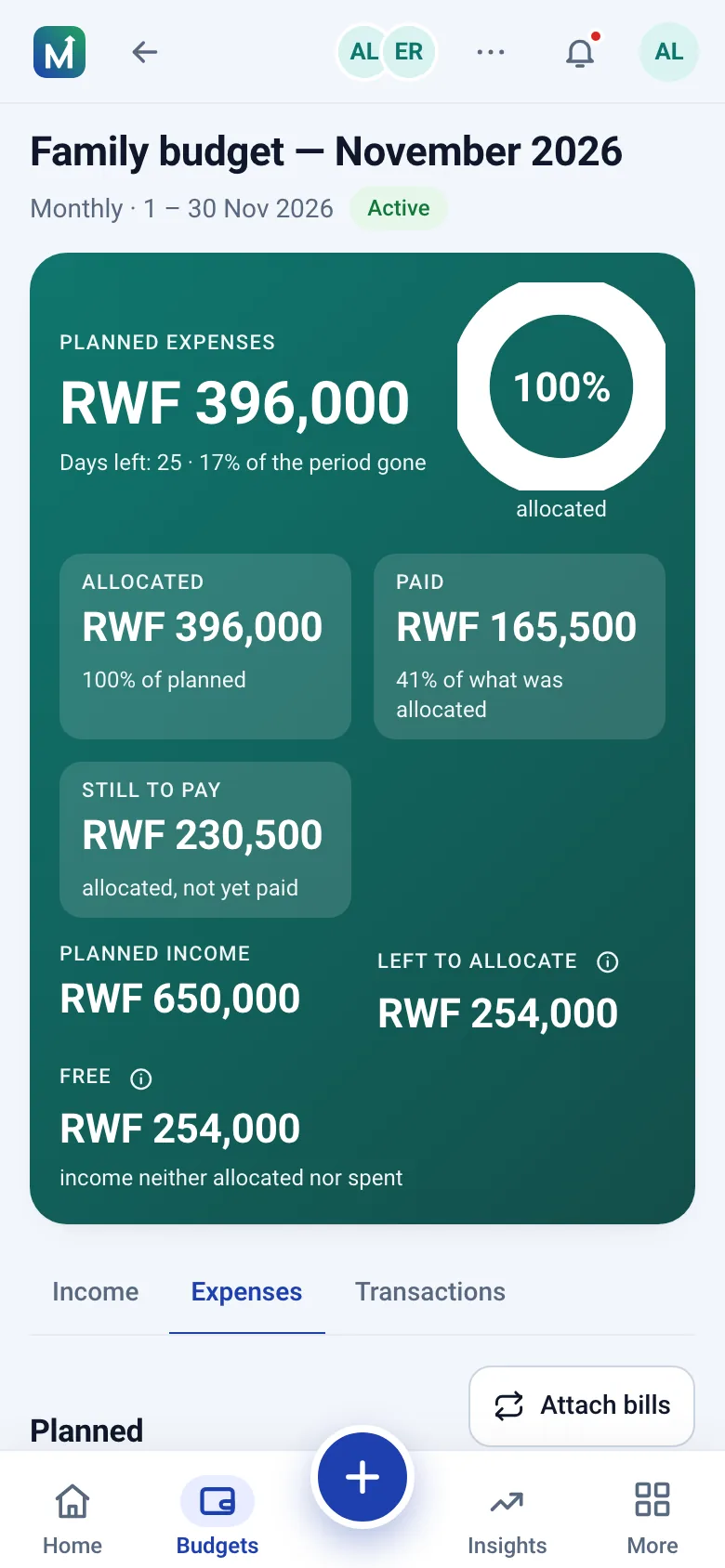
An allocation is an amount you set aside for one entry: RWF 20,000 for rice now, RWF 10,000 more later, or part of a planned amount released at a time. It draws on the budget's planned income, so nothing can be allocated before income is added, nothing beyond what is still available to allocate, and nothing beyond the entry's planned amount unless the budget's overspend policy is allow. From that moment the money is used: it leaves Free and shows under Allocated.
Payments are then recorded inside the allocation. A payment on an entry with nothing allocated is refused, and a payment larger than what is left of the allocation is refused with the figures, so execution can never overtake the money set aside. Each entry reads Not paid, Partially paid or Fully paid from its approved payments.
- Left to allocate = planned income − allocated
- Still to pay = allocated − paid
- Outside the plan = spending with no allocation behind it
- Free = income − (allocated + outside the plan), never below zero
Zero-based budgeting: every unit assigned
A budget created with the zero-based method must plan exactly its expected income plus whatever was carried in: the planner refuses to save a plan whose total differs and states the difference. Allocation then works as above, so a zero-based month is one where the plan equals the income and the allocations equal the plan. The simple method keeps the same four numbers but lets the total differ; when planned expenses outgrow planned income the budget says so and shows the shortfall.
How this compares with envelope budgeting
An envelope is an allocation: money set aside for one purpose that you spend down. Three things differ. The envelope draws on planned income rather than cash in a drawer, so a household can allocate before the salary lands and record the income when it arrives. A payment larger than the envelope is refused rather than quietly borrowed from another one; you release more first, with a note. And an envelope can be released again, never below what has already been paid, so the history of every move stays readable.
Approvals release money in tranches
In a shared or project space the approved and allocated figures are decisions. A budget can require plan approval before it is activated, a revision can be proposed and decided by an approver, and a budget that releases money by hand starts every line at Not allocated until a manager allocates it or runs Allocate all planned. The separation of duties is enforced on the server: the person who submitted a plan cannot approve it, except the space owner in a two-person household.
Step by step
Plan a month with allocations
The journey the Help page calls Plan a month, as it runs in the app.
- Create a budget: a name and the period it covers.
- Add the income that funds it on the Income tab.
- Plan expenses by section and item, or attach your bills so each occurrence becomes an entry.
- Activate the plan, then allocate each entry when the money is set aside.
- Record payments inside the allocation. Still to pay and Free update with every record.
In short
Plain facts
- In Moneva an allocation is money set aside for one planned entry; it draws on the budget's planned income and counts as used from the moment it is set.
- Payments on an entry may not exceed its remaining allocation, and an entry with nothing allocated refuses payments.
- Free equals planned income minus money used (allocations plus spending outside them) and is never shown below zero.
- A zero-based budget must plan exactly its expected income plus carry-in; the planner states the difference otherwise.
- Every line carries planned, approved, allocated and actual amounts; available is allocated minus actual, committed and pending.
Questions
Questions people ask
Is allocation budgeting the same as envelope budgeting?
Close. An allocation is a digital envelope: money set aside for one entry. Unlike a cash envelope it draws on planned income, refuses a payment larger than what is left, and keeps the history of every release.
Does Moneva support zero-based budgeting?
Yes. Choose the zero-based method when creating a budget and the plan must equal expected income plus carry-in; the planner refuses to save anything else and states the difference.
What happens to money I allocated but did not spend?
It stays allocated and shows as Still to pay. Release it with a note to return it to Left to allocate, or carry the remaining plan into the next period when you duplicate the budget.
Can I record an expense without allocating first?
Not on a planned entry: the record is refused with the amount available to allocate. Spending with no plan behind it is still recorded and shows as outside the plan, so nothing is hidden.
Related pages
Allocate one month, honestly
Create an account, add the income you expect and set money aside entry by entry.