

Debts
A debt tracker for both directions
Moneva's debt tracker records money people owe you and money you owe, with the date it started, when it is due and every payment until it is paid back. Repayments are ordinary expenses or income in your budget, so the debt page and the month always agree, and the whole module can sit behind a PIN.
- They owe me · I owe
- Part payments until settled
- Optional 4-digit PIN lock
Two directions, one list
A debt is recorded as They owe me (money coming back to you) or I owe (money you must pay back), with the person or business, an optional contact, the original amount in the space's currency, the date it was incurred, an optional due date and notes. The list keeps the two directions apart, shows what is still open per currency, flags Overdue when a due date has passed, and finds a name as you type.
Payments that add up
Record each payment from the debt, or link a record you made from the add button to it. A payment counts once it is approved, may not exceed what is still owed, and the debt moves from open to settled on its own when the last one lands. Close a debt with a reason when the rest is written off, reopen it if the situation changes; payments are reversed, never deleted, so the history stays honest.
- You owe: the payment is an expense on Financial › Debt repayment
- They owe you: the receipt is income on Debt repayment received
- No budget is required: a repayment never waits on a plan
Debts inside the budget plan
A planned entry under Financial › Debt repayment can name the debt it repays. Paying that entry records the transaction and the debt payment in one step, so the loan from a relative, the shop credit and the sacco instalment are planned, allocated and paid like any other expense, and the debt's remaining balance follows.
What the records say
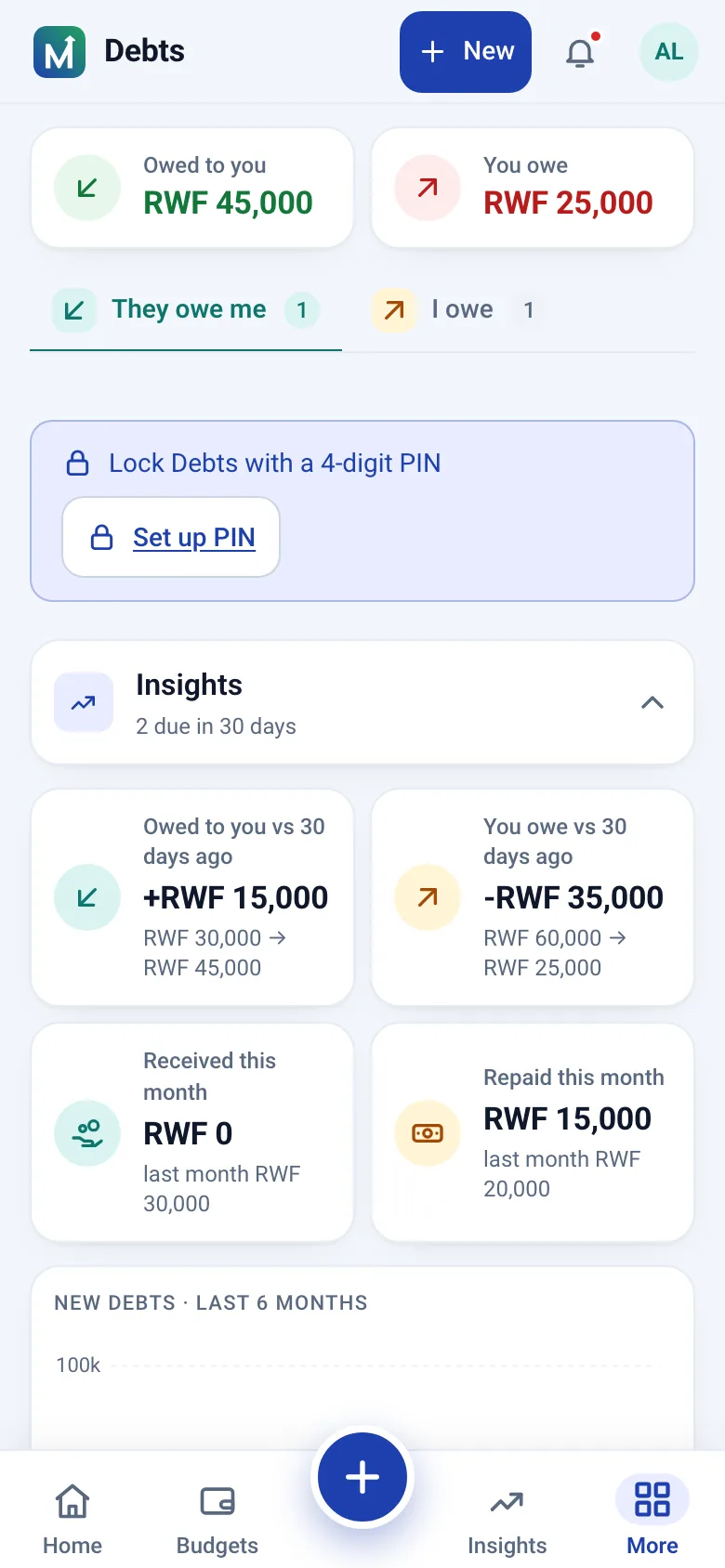
Above the list, Moneva compares what is owed to you and what you owe with thirty days ago, shows repayments received and repaid this month against last month, and lists what is due in the next thirty days, overdue first. Six-month charts show new debts (lent and borrowed) and repayments (received and repaid). Behaviour cards state their rule in one line: debts overdue and their amount, whether you lend more than you borrow, the median number of days a debt takes to settle, who pays back on time (three of four), and whether repayments came in steadily.
Private, and lockable
Non-members of a space never reach its debts. A member sees the debts they recorded; owners, admins, budget managers and approvers see every debt of the space. Debts never appear in the activity feed. From Settings → Security you can lock the Debts module behind the account's 4-digit PIN: every debts page then asks for it once an hour, five wrong attempts pause the PIN for fifteen minutes, and your password always unlocks it.
Step by step
Track a debt in Moneva
The Track a debt journey from the Help page.
- Add a debt: who, which way it goes, how much, when it is due.
- Record each payment from the debt, or link a record to it; part payments add up.
- Close it with a note when the rest is written off; reopen if needed.
In short
Plain facts
- A debt in Moneva goes one of two ways: They owe me or I owe, with the person, the original amount, the date incurred and an optional due date.
- Payments count once approved, never exceed what is still owed, and settle the debt automatically when they reach the original amount.
- A repayment you make is an expense under Financial › Debt repayment; money paid back to you is income under Debt repayment received.
- The Debts module can be locked behind a 4-digit PIN; an unlock lasts sixty minutes and the account password always unlocks it.
- Debts never appear in the activity feed and are never deleted; payments are reversed instead.
Questions
Questions people ask
Can I track money a friend owes me and money I owe the shop?
Yes. Each debt has a direction. They owe me lists what comes back to you; I owe lists what you must pay. Both sides show what is still open.
Does a repayment count as spending?
A repayment you make is an expense on the Debt repayment category, so it shows in your month. Money paid back to you is income. Neither is ever added across currencies.
Can the household see my debts?
Debts recorded in a personal space are yours alone. In a shared space, members who may view all transactions see every debt; others see only the debts they recorded. Debts never appear in the feed.
What happens when someone never pays the rest?
Close the debt with a reason. The payments stay, the rest is written off, and you can reopen it later if money arrives after all.
Related pages
Write down who owes what
Create an account, add the first debt and record the next payment from it.